Beyond the Silos: Deploying a Modern AI Orchestration Platform for Financial Services

Most financial services organizations are not short on AI ambition. They are short on AI coherence. HR, Finance, and Customer Service each run separate assistants. None of them communicate or share institutional knowledge across the enterprise. The result is fragmentation, governance risk, and AI investments that never reach their full potential.
For an industry where precision, auditability, and compliance are non-negotiable, that fragmentation is not just an efficiency problem. It is a structural one.
A dedicated AI orchestration platform solves this by acting as an intelligent central control plane. It coordinates distinct AI models, legacy systems, and digital agents into a unified, compliant execution layer without requiring banks to rip and replace their existing core infrastructure. IBM watsonx Orchestrate was built to do exactly that. And for financial services organizations already running IBM infrastructure, the path to deploying it is more direct than most expect.
Why Task-Level Automation Falls Short in Complex Banking Environments
Traditional workflow tools are built on deterministic logic. If A happens, do B. That approach works reasonably well for simple, linear tasks in predictable environments. It breaks down quickly when faced with the complexity, variability, and exception-handling demands of a real financial services operation.
The problem is not that task-level automation is useless. It is that financial institutions do not just need fast, linear execution. They need an adaptive AI orchestration platform that can evaluate parameters, route exceptions dynamically, and manage end-to-end workflows that touch multiple systems simultaneously. A loan application does not move in a straight line. A fraud alert does not resolve through a single predetermined path. Compliance checks do not happen in isolation from the underlying processes they are meant to govern.
Rigid task scripts cannot handle that reality. When conditions vary even slightly from what the automation was built to expect, the process stalls, exceptions pile up, and human teams end up manually bridging the gaps that automation was supposed to eliminate. The institutional knowledge is embedded in your core systems, and bolting automation onto the outside of those systems never produces the results the original investment promised.
“What has been missing is a layer that connects everything — one that sits across your existing infrastructure, coordinates specialized agents, routes work intelligently, and maintains full governance and auditability throughout.”
How an AI Orchestration Platform Transforms Financial Operations
1. Accelerating Complex Loan Origination Cycles
Loan origination involves a sequence of handoffs between systems, teams, and compliance checkpoints that traditional automation has never handled gracefully. Documents need to be captured and classified. Data needs to be validated against multiple sources. Compliance checks need to run in parallel with underwriting workflows. Exceptions need to be flagged and routed to the right people without losing track of where the overall process stands.
With watsonx Orchestrate, supervisor agents coordinate specialized collaborators across each stage of the process from a single interface. No custom code is required to connect the workflow across systems. The mechanical execution runs automatically, the people in the process stay in the loop for decisions that require genuine judgment, and every action is traceable and auditable from end to end. Deals that previously closed late because of handoff delays and manual review cycles move faster because the coordination work that slowed them down is no longer dependent on human intervention at every step.
2. Intelligent Compliance Monitoring and Real-Time Fraud Triage
Compliance-driven workflows demand a level of precision and auditability that generic AI tools are not designed to deliver. Regulators do not just want to see that a decision was made correctly. They want to understand why it was made, what data informed it, and what controls were in place throughout the process.
watsonx Orchestrate is built with that requirement at its core, not as an afterthought. Real-time observability, Role-Based Access Controls, SOC2 and ISO27K compliance, and built-in guardrails are part of the platform. Every agent action is traceable and explainable. For fraud triage specifically, agents assess incoming signals, route cases dynamically based on risk parameters, and escalate to human reviewers for the decisions that warrant human judgment, all within a governance framework that satisfies regulatory expectations and gives compliance teams the visibility they need.
3. Unifying the Front and Back Office into a Singular Digital Workforce
One of the most significant costs in financial services operations is the friction between front-office customer interactions and back-office execution. A customer service inquiry that requires information from a document repository, a workflow system, and a core banking platform should not require three separate handoffs and a two-day resolution window. It rarely has to.
AI agents deployed across voice, chat, and digital channels can handle high-volume, rule-based interactions while seamlessly escalating to human agents for the cases that genuinely require judgment. Integration with platforms like Genesys enables AI-to-human handoff without the customer experience breaking down at the transition point. IBM’s own deployment of watsonx across their HR and customer service operations reduced cost per interaction from fifteen dollars to under two dollars and dropped resolution time from hours to minutes. For financial services organizations running high-volume contact center operations, those economics translate directly to the bottom line.
The same orchestration layer that handles customer-facing workflows connects to back-office invoice processing, approvals, and finance operations. Agents capture, classify, and route transactions through approval chains, flagging exceptions and updating ERP systems without human intervention for straightforward cases. The people in the process handle the exceptions. The mechanical execution runs automatically.
See what AI agents can do for your bank Put governed, multi-agent orchestration to work across your existing systems.
Explore AI Agents
Ensuring Ironclad Security, Governance, and Explainability
Modern AI for financial services must be fully auditable. That is not a feature request from progressive institutions. It is a regulatory reality for all of them.
watsonx Orchestrate delivers centralized visibility across every automated workflow, Role-Based Access Controls that ensure the right people have access to the right processes, and precise compliance metrics that give human regulators full transparency into the reasoning behind every automated decision. The governance model is not layered on after deployment. It is built into the architecture from the ground up.
For organizations with data residency requirements or regulatory constraints on cloud deployment, the platform runs on IBM Cloud, AWS, or on-premises. For organizations that have already moved parts of their infrastructure to the cloud, the open and hybrid architecture means watsonx Orchestrate meets them where they are without forcing a choice between compliance and capability.
The platform also supports IBM Granite and third-party large language models, and connects to over 700 pre-built integrations including SAP, Salesforce, ServiceNow, Microsoft 365, Workday, and Genesys, alongside the full IBM stack including FileNet P8, Business Automation Workflow, and Datacap Intelligent Capture. There is no rip-and-replace. The orchestration layer builds on the infrastructure you have already invested in.
Governance built into the architecture — not bolted on after deployment — is what separates an orchestration platform that scales in a regulated bank from one that stalls.
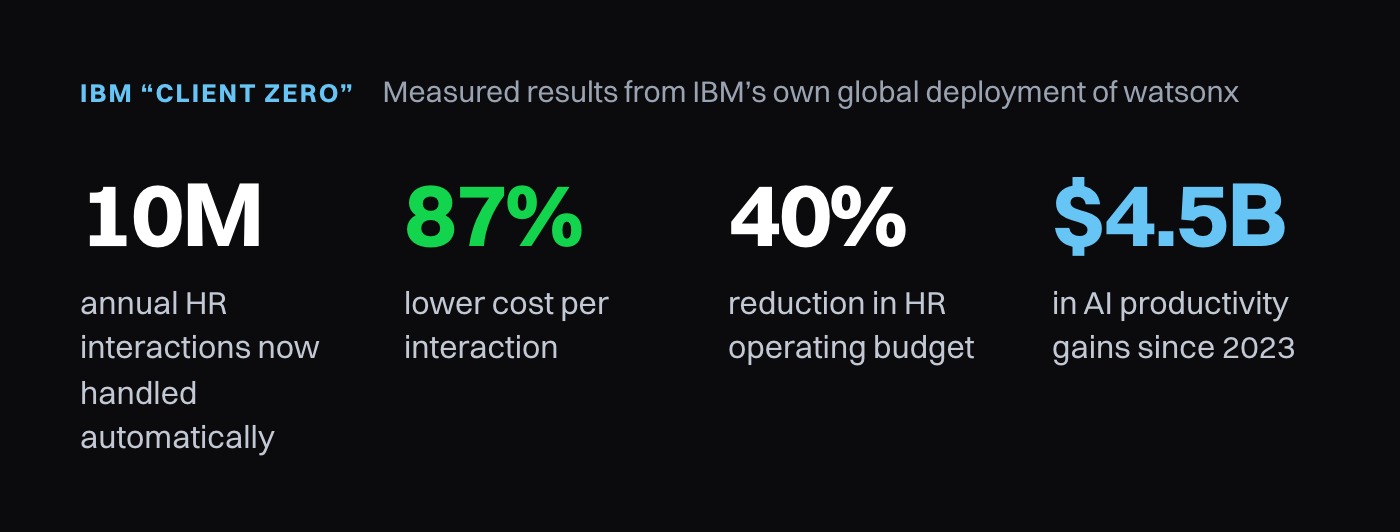
IBM’s own deployment of watsonx across their global operations produced results worth understanding before any other case study. Ten million annual HR interactions now handled automatically. Cost per interaction reduced by 87 percent. HR operating budget reduced by 40 percent. 4.5 billion dollars in AI productivity gains since 2023. These are not analyst projections. They are IBM’s own measured outcomes from their own production environment.
Deploying Agentic AI for Financial Services Safely with a Trusted Implementation Partner
The difference between an AI orchestration platform that delivers results and one that stalls in a lengthy implementation is almost never the technology itself. It is the team implementing it and how well they understand the infrastructure it is connecting to.
enChoice has been delivering IBM automation to enterprise organizations for over 30 years. Our team members average more than 20 years of IBM-specific expertise across FileNet, Business Automation Workflow, Datacap, and the broader IBM content and automation stack. When we connect watsonx Orchestrate to your existing infrastructure, we are not learning on the job. We have done it hundreds of times, across more than 800 enterprise clients, across every major vertical.
Our engagement model moves organizations from discovery to production pilot in weeks, not months, starting with a two-to-four hour Discovery Workshop where we map your IBM environment, identify the highest-value orchestration use cases, and define success metrics before any broader commitment is made. From there we design your agent framework, build and deploy a production-ready pilot, and measure real outcomes against defined KPIs.
enChoice is an IBM Gold Business Partner, certified across watsonx Orchestrate, FileNet, BAW, Datacap, CMOD, and CP4BA. We are not a software reseller. We architect, build, test, deploy, and support, owning the complete engagement from discovery through production and staying with you well beyond go-live.
If your organization is ready to move beyond fragmented AI deployments and build a governed, connected orchestration layer across your operations, the place to start is a conversation about where your highest-value opportunities are and how your existing infrastructure maps to them. Schedule a Discovery Call to get started.
Relevant links
About enChoice
enChoice celebrates over 30 years as an award-winning Business Automation solutions company. As a Gold IBM business partner, enChoice software, services, and support help fuel our customers’ AI journey by leveraging the latest AI tools to optimize content and business processes. Discover why over 800 leading companies have chosen enChoice as their trusted advisor. To learn more, visit: www.enChoice.com