Our Guide to Enterprise AI Orchestration Tools

Managing a modern digital workforce means moving past single-purpose bots. A chatbot that answers one kind of question, or a script that automates one linear task, can deliver value in isolation. But the moment an enterprise is running dozens of these tools across HR, finance, customer service, and operations, it produces the same fragmentation that disconnected human teams do: duplicated effort, no shared context, and no single point of governance. True scaling demands an enterprise-wide AI orchestration platform that acts as a central control plane to coordinate, govern, and deploy autonomous enterprise AI agents across multi-system tech stacks.
This guide explains what AI orchestration tools actually do, how they differ from the workflow automation that came before them, which platforms lead the market today, and the four pillars that should anchor any serious evaluation.
What Are AI Orchestration Tools?
AI orchestration tools are the coordination layer for a digital workforce. Where a single agent performs a task, an orchestration platform manages how many specialized agents, models, and systems work together to complete an end-to-end business process under unified control. The core architectural pattern is the supervisor agent. A request arrives, the supervisor interprets intent, determines which specialized collaborator agent is best positioned to handle each step, routes the work across the systems involved, and keeps the whole process traceable from start to finish. State is maintained, exceptions are surfaced, and high-stakes actions can pause for human approval before they execute.
That distinction matters because most AI deployed in enterprises today is still a collection of point solutions. An orchestration platform is what turns those isolated capabilities into a governed, observable system that can actually scale, and the organizations that capture value from that shift will be the ones that orchestrated their agents rather than simply accumulating them.
“40% of enterprise applications will embed task-specific AI agents by the end of 2026, up from less than 5% in 2025.”
— Gartner forecast, 2026
AI Orchestration vs Traditional Workflow Automation
Traditional workflow automation runs on deterministic logic: if A happens, do B. That works well for predictable, linear processes, and it remains useful for exactly those. It breaks down when conditions vary, when a process spans multiple systems at once, or when handling an exception requires judgment rather than a pre-written rule.
AI orchestration is adaptive rather than deterministic. Instead of following a fixed script, the platform evaluates parameters, routes work dynamically, and coordinates multiple agents across systems in real time. A claim, a loan application, or a procurement request rarely moves in a perfectly straight line, and orchestration is built for the branches, the exceptions, and the parallel checks that rigid automation cannot accommodate.
The practical difference for a buyer is this: workflow automation eliminates repetitive steps within a system, while AI orchestration coordinates intelligent work across every system, with governance and auditability maintained throughout.
The Top AI Orchestration Tools for Today’s Buyers
The market divides into three broad categories, and identifying which one fits your operating model is the most important decision before you compare features. Enterprise managed platforms provide governance, integrations, and operational tooling out of the box. Developer frameworks give engineering teams fine-grained control but require them to build and run the surrounding infrastructure. No-code automation tools let business users assemble workflows quickly, with less depth on enterprise governance and scale. The platforms below are among the most frequently evaluated in enterprise selection.
- IBM watsonx Orchestrate. A multi-agent orchestration platform for building, deploying, and governing AI agents across the business, with a heavy emphasis on explainability, auditability, and native governance. Best suited to large and regulated enterprises that need multi-agent coordination across hybrid cloud and on-premises environments without replacing existing infrastructure.
- Microsoft Copilot Studio and Azure AI Foundry. Microsoft’s agent stack spans Copilot Studio for business-user agents and Azure AI Foundry Agent Service for pro-code, CI/CD-oriented deployments. A natural fit for organizations already standardized on Microsoft 365 and Azure.
- Salesforce Agentforce. Built for customer-facing automation, with agents operating directly on the Salesforce data model so they act on live records without a separate synchronization layer. Strongest for enterprises where Salesforce is the primary CRM.
- Google Vertex AI Agent Builder. A managed environment for building and running agents on Google Cloud, with access to Gemini models and early support for emerging agent-interoperability standards. Best for teams already invested in Google Cloud and its data services.
- UiPath Agentic Automation Platform. Coordinates AI agents, RPA bots, and human reviewers under a single orchestration model built around business-process modeling. A fit for organizations with mature RPA estates extending automation into agentic territory.
- Developer Frameworks (LangGraph, CrewAI, and others). Open frameworks such as LangGraph and CrewAI give engineering teams maximum control over agent behavior, state, and coordination. They are powerful building blocks, but the enterprise itself is responsible for the governance, security, integration, and operational layers that managed platforms provide by default.
See what AI agents can do for you Put governed, multi-agent orchestration to work across your existing systems.
Explore AI Agents
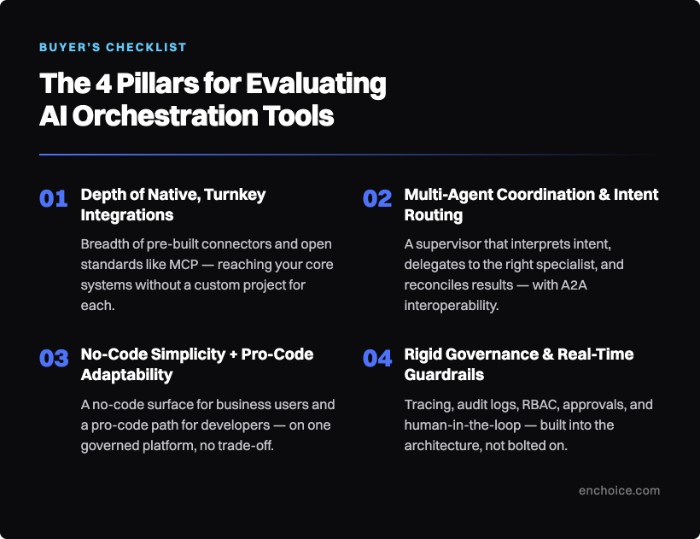
4 Non-Negotiable Pillars for Auditing Enterprise AI Orchestration Tools
Marketing language across these platforms overlaps heavily, and almost every vendor can demonstrate a polished agent in a controlled environment. The tools that survive in production are distinguished by four capabilities. Use them as a checklist when you evaluate any AI orchestration platform.
- Depth of Native, Turnkey Integrations. An orchestration platform is only as valuable as the systems it can reach. The institutional knowledge an enterprise depends on already lives inside its core applications, so the real question is how many of those systems the platform connects to natively, without a custom integration project for each one. Open standards matter here too: the Model Context Protocol (MCP) has become the common interface between agents and the tools and data they act on, reducing integration cost and vendor lock-in. Look for breadth of pre-built connectors and support for open protocols, not a promise to build connections later.
- Multi-Agent Coordination and Intent Routing. Coordinating one agent is straightforward. Coordinating many, so a supervisor interprets intent, delegates to the right specialist, and reconciles the result, is the actual hard problem of orchestration. Evaluate how the platform models multi-agent workflows, how it routes intent, and whether it supports agent-to-agent communication standards such as the A2A protocol that let agents built on different systems interoperate. Shallow tools demo a single agent well and fall apart when agents have to hand off to one another.
- No-Code Simplicity Paired with Pro-Code Adaptability. Business teams need to compose and adjust agents without waiting on engineering for every change, and engineers need the depth to handle complex, custom logic when a process demands it. A platform that offers only one of these forces a trade-off between speed and capability. The strongest tools provide a no-code or low-code surface for business users and a pro-code path for developers on the same governed platform.
- Rigid Enterprise Governance and Real-Time Guardrails. This is where an evaluation should start, not end. Tracing, audit logs, role-based access, approvals, and human-in-the-loop controls are mandatory for production, not optional extras. Without trace-level visibility into every tool call and decision, debugging a production failure becomes guesswork, and an agent acting without guardrails on a sensitive system is a liability rather than an asset. Gartner has warned that more than 40% of agentic AI projects are at risk of cancellation by 2027, with weak governance and unclear value among the leading causes. Governance has to be built into the architecture, not bolted on after deployment.
Why IBM watsonx Orchestrate is the Architectural Benchmark
Measured against those four pillars, IBM watsonx Orchestrate is the reference point for what enterprise-grade orchestration should look like.
On integration depth, it connects to over 700 pre-built integrations including SAP, Salesforce, ServiceNow, Microsoft 365, Workday, and Genesys, alongside the full IBM stack of FileNet P8, Business Automation Workflow, and Datacap Intelligent Capture, with no rip-and-replace required. On multi-agent coordination, its supervisor-and-collaborator architecture routes intent across systems from a single interface and supports IBM Granite and third-party large language models. On flexibility, it pairs a no-code building experience with pro-code adaptability. And on governance, real-time observability, role-based access controls, SOC2 and ISO27K compliance, and native guardrails are part of the platform, with every agent action traceable and explainable, the differentiator that matters most at audit time in regulated industries.
The most persuasive proof is that IBM ran the platform on itself first. Deployed across IBM’s own HR, finance, and customer service operations as “Client Zero,” watsonx Orchestrate now handles ten million annual HR interactions automatically. Cost per interaction dropped from $15 to $1.95, an 87% reduction. HR operating budget fell by 40%. IBM reports $4.5 billion in AI productivity gains since 2023. These are not analyst projections; they are IBM’s own measured results from its own production environment. For organizations deciding where to anchor an orchestration strategy, watsonx Orchestrate sets the benchmark.
Software is Only as Good as your Implementation Partner
The single most overlooked factor in an AI orchestration evaluation is not on any feature-comparison chart. The difference between a platform that delivers results and one that stalls in a lengthy implementation is rarely the software itself. It is the team connecting it to your environment and how well they understand the systems it has to reach.
enChoice has been delivering IBM automation to enterprise organizations for over 30 years. Our team members average more than 20 years of IBM-specific expertise across FileNet, Business Automation Workflow, Datacap, and the broader IBM content and automation stack, and we have delivered across more than 800 enterprise clients in every major vertical. When we connect watsonx Orchestrate to your existing infrastructure, we are not learning on the job.
enChoice is an IBM Gold Business Partner, certified across watsonx Orchestrate, FileNet, BAW, Datacap, CMOD, and CP4BA. We are not a software reseller. We architect, build, test, deploy, and support, owning the engagement from a Discovery Workshop that maps your environment and the highest-value use cases, through a production-ready pilot delivered in weeks, not months, and well beyond go-live.
If you are evaluating AI orchestration tools, the most useful next step is a conversation about how your existing infrastructure maps to the highest-value opportunities. Schedule a Discovery Call to get started.
Relevant links
About enChoice
enChoice celebrates over 30 years as an award-winning Business Automation solutions company. As a Gold IBM business partner, enChoice software, services, and support help fuel our customers’ AI journey by leveraging the latest AI tools to optimize content and business processes. Discover why over 800 leading companies have chosen enChoice as their trusted advisor. To learn more, visit: www.enChoice.com