IBM Content Cortex: What FileNet Customers Need to Know

IBM has renamed and re-platformed FileNet to Content Cortex. The good news is that if you are on FileNet Content Manager today, this is not going to be a migration, but it will be a part of the standard upgrade process with some additional features.
Here’s what’s changed, what you get out of the box, and what’s coming next.
Content Cortex Is FileNet Evolved, Not a Replacement
IBM Content Cortex, released June 26, 2026, unifies IBM FileNet Content Manager, Content Manager OnDemand (CMOD), and Content Manager Enterprise Edition (CM8), into a single, AI-ready content services platform.
For customers already running FileNet Content Manager, this is considered a new release with a name change rather than a platform swap. The backend, data model, database, and existing user interfaces continue to function as they do today. No forced migration, no rip-and-replace. In most cases, FileNet Content Manager licenses convert automatically to Content Cortex Essentials Edition. For Cloud Pak for Business Automation (CP4BA) customers Content Cortex Essentials will be in the CP4BA license.
The story is different for organizations still on CM8, or Content Manager OnDemand. For those platforms, IBM will continue to support both products for the foreseeable future. What’s changing is where IBM’s investment goes: going forward, CM8 and CMOD should be expected to receive minimal new innovation, while all major new feature investment is concentrated in Content Cortex.
In practical terms, that makes Content Cortex the long-term direction to plan toward, even though today’s CM8/CMOD environments remain fully supported.
The IBM Licensing Terms are changing
While you’ll retain your existing license type, Content Cortex introduces a new metric you’ll need to monitor: Content Operations.
A Content Operation is any API call invoked by a user, system, or AI agent. In practice, this means every interaction with Content Cortex generates an API call and counts as one Content Operation, whether that’s a human user clicking through Content Navigator, an AI agent performing an action, a service account running a batch process, or an integration calling the REST API. It doesn’t matter who or what triggers the call; each one counts the same.
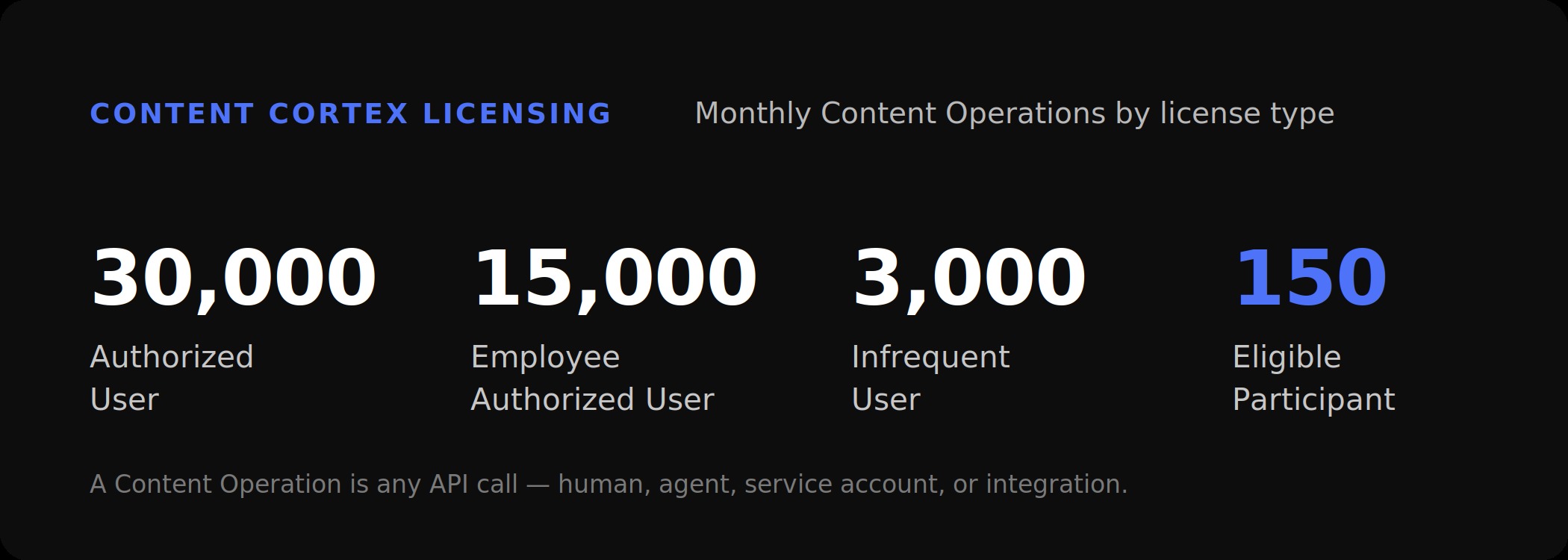
Each license type carries a monthly Content Operations limit (confirm your specific entitlement against your license agreement, as eligibility varies):
- Authorized User: 30,000 Content Operations per month
- Infrequent User: 3,000 Content Operations per month
- Employee Authorized Users: 15,000 Operations per month
- Eligible Participant: 150 Content Operations per month
What You Get With Content Cortex Essentials
Essentials is positioned as the foundation for an AI-ready content platform, and it ships with substantially more capability than previous versions of FileNet. Based on IBM’s own documentation and product materials, Essentials include:
- Remote MCP Server: Native Model Context Protocol connectivity that lets AI models and agents work directly against your content repository, without custom point-to-point integrations. It’s built to work with any MCP-compatible AI runtime: watsonx Orchestrate, Claude, Microsoft Copilot, or ChatGPT.
- Intelligent Archiving: Up to 30:1 compression for long-term, static content (think account statements and tax documents) with instant retrieval, so a single platform covers both active and archival content instead of maintaining a separate archival system.
- Navigator Core Agent: Natural-language access to content directly inside IBM Content Navigator: ask questions, retrieve documents, and execute tasks without switching tools.
- Enterprise Security and Governance: Fine-grained access controls enforced natively across both documents and their AI-generated semantic representations (embeddings, extracted text, etc.). When a document is deleted, its derived embeddings are deleted with it, governance by architecture, not by policy alone.
- Business Automation Insights: Operational dashboards covering content performance, lifecycle status, and governance compliance in near real time.
- Retention and Disposition: Legally defensible, fully auditable retention and disposition policies that scale across billions of documents.
- Enhanced text extraction: A pluggable extraction framework that unlocks previously inaccessible content, including handwritten notes, complex tables, and image-based documents, improving accuracy for downstream AI and automation.
"If you’re already entitled to FileNet Content Manager or CP4BA, you already have the MCP connectivity layer, the archiving upgrade, and the governance controls needed to start real agentic AI pilots against your existing content, without an additional purchase."
Content Cortex Premium: Announced, Not Yet Live
IBM announced Content Cortex Premium Edition on September 1, 2026, with a planned availability date of September 25th, 2026. As of this writing, while Premium has not yet shipped, it’s the natural next step for organizations with more AI use cases than what Essentials cover.
Per IBM’s own announcement, Premium Edition extends Essentials with:
- Additional, specialized AI agents: purpose-built agents for legal hold, redaction, and document insights (summarization, comparison, Q&A), in addition to the general-purpose MCP connectivity Essentials provides.
- Additional remote MCP servers, ready for immediate use: building on the core MCP server in Essentials with more specialized MCP server variants for those dedicated agent workflows.
- Expanded agentic experiences across the user interface: AI embedded directly into content-intensive tasks and processes, not just accessible through a chat panel or an external agent runtime.
- Agentic Hybrid RAG with Smart Search: AI agents dynamically combine semantic, keyword, and metadata search against IBM Content Assistant’s vector database, reasoning about which retrieval methods to use, whether evidence is sufficient, and when to search again, rather than routing every query through one fixed search process.
How This Ties Into CP4BA
For organizations running Cloud Pak for Business Automation, Content Cortex slots in as the content services layer rather than a separate platform to stand up from scratch:
- CP4BA customers already have Essentials available to start using the base MCP server, intelligent archiving, or governance features.
- The rest of CP4BA is unaffected. Business Automation Workflow, Case Manager, Datacap, ODM, and RPA continue to operate exactly as they do today; Content Cortex only changes the content services component underneath them.
- AI Services deploys via a dedicated operator (CCXAIServices) on OpenShift or CNCF Kubernetes, connecting to your Content Platform Engine, Content Navigator, and Content Cortex GraphQL API. For CP4BA environments specifically, enabling external MCP clients (For example, Claude Desktop, watsonx Orchestrate, Copilot Studio).
You don’t have to containerize everything to get AI Services. As of interim fix 2 (August 2026), IBM added support for deploying the AI Services operator as a standalone containerized component alongside a traditional, non-containerized WebSphere Application Server deployment. Your core Content Platform Engine can stay right where it is; only the AI reasoning and MCP layer needs to run in containers, connecting back over HTTPS. This lowers the bar for CP4BA and traditional FileNet customers who want to implement AI Services.
Not sure what Content Cortex changes for you? We map your entitlements, demo the new AI capabilities live, and build a road map you can act on.
Learn more
The Bottom Line
If you’re on FileNet Content Manager or CP4BA today, Content Cortex is already available to you, just under a new name, and with new capabilities. Deciding what to do next shouldn’t be a guess. This is a consultative process: enChoice works alongside your team to demonstrate the new AI capabilities live, whether that’s through Claude, Microsoft Copilot, or watsonx Orchestrate, and to talk through the use cases that actually matter to your business. From there, we help you shape a strategy and a practical road map, so you know which capabilities to move on now, what to plan for as Premium arrives, and how each step ties back to your objectives. There is a lot of new information to absorb here, and demystifying it is exactly where we start.
The questions we’re hearing from our customers recently are -
- What does a first agentic pilot involve?
- Is Premium worth it or does Essentials already cover us?
- We are CM8/CMOD customers - how should we be planning?
About enChoice
enChoice celebrates over 30 years as an award-winning Business Automation solutions company. As a Gold IBM business partner, enChoice software, services, and support help fuel our customers’ AI journey by leveraging the latest AI tools to optimize content and business processes. Discover why over 800 leading companies have chosen enChoice as their trusted advisor.